
Developed by UCLA, SDSC, and TACC
OneSciencePlace (OSP) is a web-based platform for delivering research and education capabilities — applications, data, and publishing through a single, coherent environment.
It is designed for institutions, projects, and research teams that need more than a simple web portal but do not want to build and maintain a custom solution from scratch. OSP provides a managed, composable foundation that can support a focused need today and grow over time as requirements expand.
What OSP Brings Together
OSP unifies four capabilities that research teams typically manage through separate, disconnected tools:
Apps — Browser-based delivery of research and educational applications, from interactive web and graphical applications (Jupyter, RStudio, MATLAB, ANSYS) to batch executables and scripts running on HPC clusters. A no-code UI builder lets administrators create custom launch interfaces without writing code.
Compute — Integration with HPC clusters, single hosts, cloud, and hybrid environments, including ACCESS and NAIRR resources. Supports Slurm, MPI, GPU workloads, and interactive sessions, with job tracking and one-click restart built in.
Data — POSIX and S3/object storage with fine-grained sharing controls, metadata annotation. Custom visualization plugins are supported for domain-specific file types.
Publishing — FAIR-compliant publishing of datasets, applications, notebooks, and workflows with DOIs, configurable metadata schemas, and multistage curation workflows.
Architecture
OSP is built on a three-layer architecture that separates the user-facing tenant environment from the shared orchestration services and the underlying compute and data resources. This separation enables each tenant to operate independently while sharing a common, managed infrastructure layer — making it straightforward to scale from a single lab portal to a national-scale science gateway on the same platform foundation. 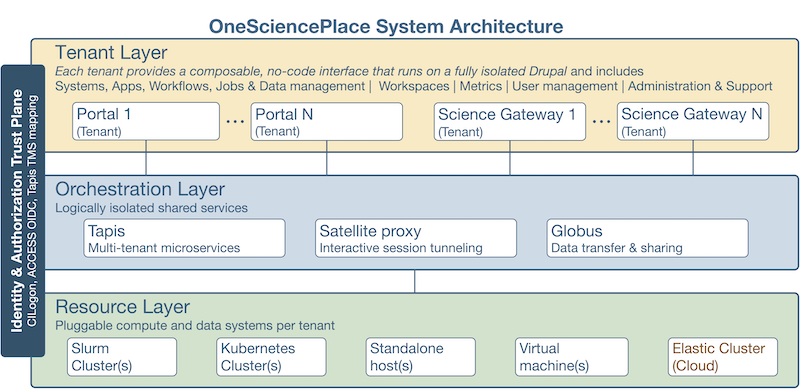
OSP's three-layer architecture — Tenant, Orchestration, and Resource — with a cross-cutting Identity and Authorization Trust Plane. Each tenant operates independently while sharing a common orchestration layer across connected compute and data systems.
The Tenant Layer provides each portal or gateway with its own isolated environment — including apps, workflows, data management, user administration, and publishing — running on a dedicated Drupal instance with no-code configuration throughout.
The Orchestration Layer provides shared, logically isolated services across all tenants — Tapis for multi-tenant job and data microservices, the Satellite proxy for interactive session tunneling, and Globus for high-performance data transfer and sharing.
The Resource Layer connects each tenant to its compute and data systems — Slurm clusters, Kubernetes clusters, standalone hosts, virtual machines, and cloud-elastic environments — entirely in user space without requiring privileged access.
A cross-cutting Identity and Authorization Trust Plane provides secure, consistent access across all layers, supporting CILogon, ACCESS OIDC, and Tapis Trust Management Service.
Who It Is For
OSP is designed for a range of users and scales:
- Faculty PIs and research teams — a lightweight lab portal for sharing applications, data, and outputs without dedicated IT support
- Instructors and workshop leaders — prebuilt application environments with simple federated sign-in for students
- Research IT and HPC centers — a reusable institutional platform that reduces custom development and ongoing maintenance
- Science gateway communities — federated access across institutions with reproducibility and FAIR publishing built in
How We Deploy With You
OSP is available today as a fully managed service. Deployment typically follows five stages:
- Define the use case — identify the applications, users, data, and infrastructure the site needs to support
- Configure the environment — set up site structure, branding, access model, and core platform components
- Connect systems — integrate identity, compute resources, storage, and related services
- Add applications and workflows — configure application launch, data handling, publishing, and user-facing interfaces
- Launch and operate — run as a managed service with infrastructure, security, and updates handled by the OSP team
An open-source distribution is in active development. Learn more
Built on a Proven Foundation
OSP builds on three decades of research cyberinfrastructure, with contributors from the teams behind Hubzero, SeedMeLab, CIPRES, Apache Airavata, and Tapis. It integrates with established platforms, including Tapis for job and data lifecycle management, and CILogon and Globus Auth for federated identity. Funded by the National Science Foundation.
Ready to go deeper? Explore platform features → See OSP in action → Discuss your use case
Not ready yet? See how OSP compares with other research computing platforms